How to Calculate Time and a Half Overtime Pay (Formula + Examples)
If you've recently put in extra hours at work, you're probably asking: how do you calculate time and a half overtime pay?
Whether you're a nurse working consecutive 12-hour shifts, a warehouse worker on weekend duty, or an hourly employee double-checking a paycheck, overtime math shouldn't feel like rocket science.
In this guide we break down the exact time-and-a-half formula, walk through step-by-step examples, cover special state rules (like California's daily overtime), and share a quick-reference pay chart.
⚡ Need a quick answer? Try our free Interactive Time and a Half Overtime Calculator to get your gross overtime earnings in seconds.
What Is Time and a Half Pay?
Time and a half is an overtime compensation rate equal to 1.5 times your standard hourly base rate.
Under the federal Fair Labor Standards Act (FLSA) in the United States:
- Non-exempt hourly employees are entitled to time and a half for every hour worked beyond 40 hours in a single 7-day workweek.
- It is the federal baseline — employers cannot legally pay less than 1.5× your regular rate for eligible overtime hours.
The Time and a Half Formula
Calculating your overtime pay takes three simple steps:
Step 1 — Overtime hourly rate
Overtime Rate = Regular Hourly Rate × 1.5
Step 2 — Total overtime earnings
Total Overtime Pay = Overtime Hours Worked × Overtime Rate
Step 3 — Total gross pay for the week
Total Gross Pay = (Regular Hours × Regular Rate) + Total Overtime Pay
Real-World Examples: How to Figure Out Time and a Half
Let's run through three realistic scenarios.
Example 1: Standard 45-Hour Week at $20/Hour
- Base rate: $20.00/hr
- Total hours worked: 45 (40 regular + 5 overtime)
- Overtime rate:
$20.00 × 1.5 = $30.00 per hour - Regular pay:
40 hours × $20.00 = $800.00 - Overtime pay:
5 hours × $30.00 = $150.00 - Total gross pay:
$800.00 + $150.00 = $950.00
Example 2: Heavy Overtime (52-Hour Week) at $26/Hour
- Base rate: $26.00/hr
- Total hours worked: 52 (40 regular + 12 overtime)
- Overtime rate:
$26.00 × 1.5 = $39.00/hr - Regular pay:
40 × $26.00 = $1,040.00 - Overtime pay:
12 × $39.00 = $468.00 - Total gross pay:
$1,040.00 + $468.00 = $1,508.00
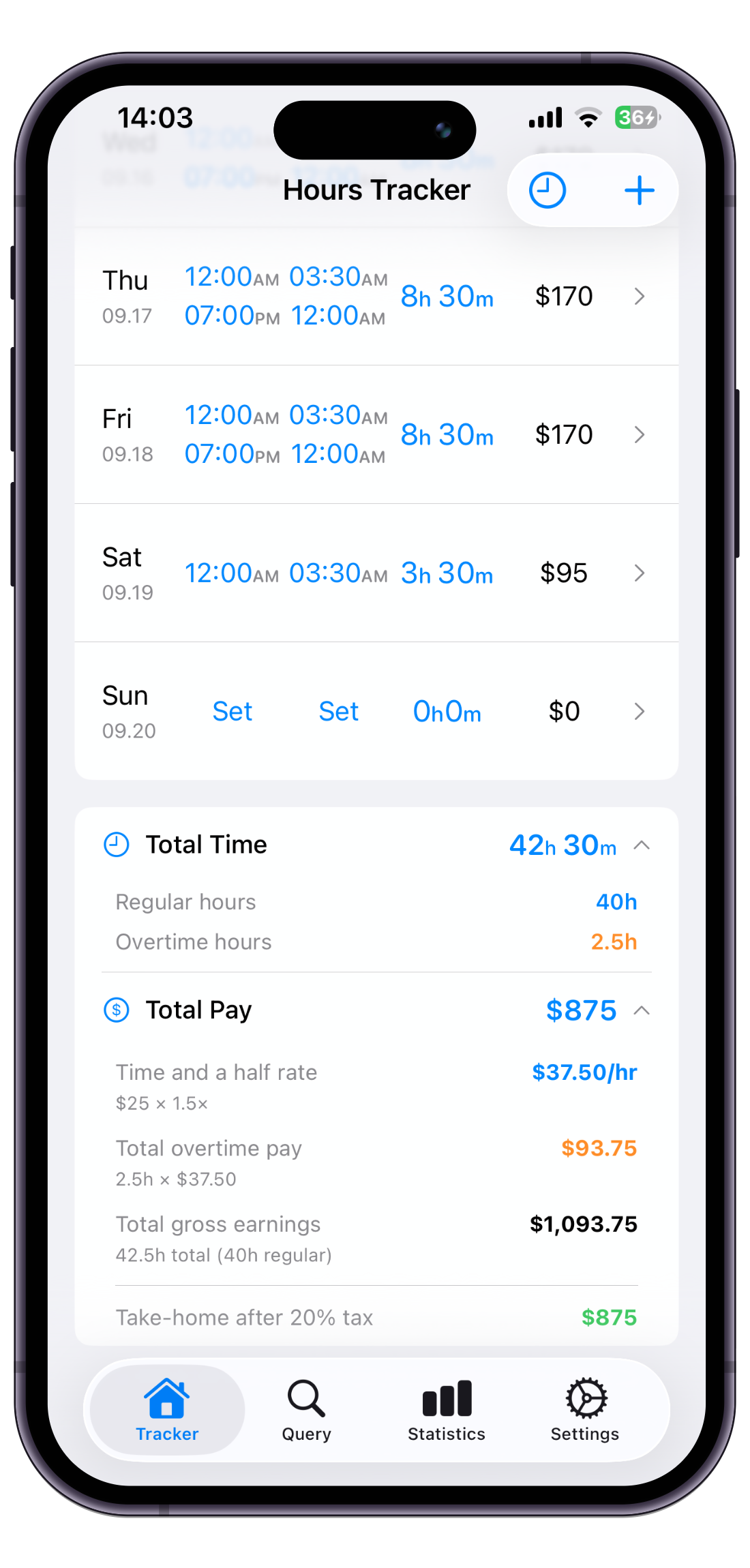
Example 3: A 3h 30m Overtime Shift at $25/Hour (Real Shift Lengths)
Real shifts rarely land on whole hours. If you earn $25.00/hr and worked 3 hours 30 minutes of overtime:
- Overtime rate:
$25.00 × 1.5 = $37.50/hr - Overtime pay:
3h 30m × $37.50 = $131.25 - Add that to your regular 40 hours (
40 × $25.00 = $1,000.00) for a gross of $1,131.25.
Time and a Half Pay Chart (Quick Reference)
Use this cheat sheet to find your time-and-a-half rate instantly:
| Base Hourly Rate | Time and a Half Rate (1.5×) | Overtime Pay (5 hrs OT) | Overtime Pay (10 hrs OT) |
|---|---|---|---|
| $15.00/hr | $22.50/hr | $112.50 | $225.00 |
| $18.00/hr | $27.00/hr | $135.00 | $270.00 |
| $20.00/hr | $30.00/hr | $150.00 | $300.00 |
| $22.00/hr | $33.00/hr | $165.00 | $330.00 |
| $25.00/hr | $37.50/hr | $187.50 | $375.00 |
| $30.00/hr | $45.00/hr | $225.00 | $450.00 |
| $35.00/hr | $52.50/hr | $262.50 | $525.00 |
| $40.00/hr | $60.00/hr | $300.00 | $600.00 |
Special Overtime Rules You Need to Know
Federal law isn't the only rulebook. Depending on where and how you work, you might earn even more.
1. California Daily Overtime (The 8-Hour Rule)
While federal law only looks at 40 hours per week, California mandates daily overtime:
- Over 8 hours in a workday: 1.5× regular rate (time and a half)
- Over 12 hours in a workday: 2.0× regular rate (double time)
- First 8 hours on the 7th consecutive workday: 1.5× regular rate
- Over 8 hours on the 7th consecutive workday: 2.0× regular rate
Other states with daily overtime rules include Alaska, Nevada and Colorado (with specific qualifiers).
2. Night Shift Differentials
If you receive a shift differential (for example, an extra $3.00/hr for overnight work), your time-and-a-half rate must include that differential:
- Regular rate:
$20.00 + $3.00 night differential = $23.00base - Overtime rate:
$23.00 × 1.5 = $34.50/hr(not $30.00 + $3.00)
3. Holiday Pay vs. Overtime
Federal law does not require private employers to pay 1.5× simply because you work on a holiday, unless those hours push you past 40 regular hours for the week. Many employers still offer holiday premium pay as company policy.
The Problem with Manual Overtime Calculations
Tracking time and a half by hand — or in a messy spreadsheet — often leads to errors:
- Unpaid break miscalculations: deducting 30-minute unpaid meal breaks incorrectly can rob you of hours.
- Midnight shift crossovers: if your shift starts at 10 PM and ends at 6 AM, tracking which day the hours belong to can cause payroll disputes.
- Shortchanged overtime rates: overtime is sometimes calculated on the base rate while mandatory shift differentials or non-discretionary bonuses are omitted.
Track Your Time and a Half Automatically with ShiftWorkLog
Tired of doing mental math every time you punch out?
With ShiftWorkLog for iOS and Android, tracking time and a half takes zero effort:
- ⏱️ One-tap shift logging: log regular shifts, overnight hours, split shifts and customized breaks.
- ⚡ Automated overtime & double time: automatically applies 1.5× (and 2.0×) rates based on weekly (40h) or daily (8h/12h) thresholds.
- 💰 Accurate pay predictions: see your gross earnings — including overtime premiums and differentials — before your paycheck arrives.
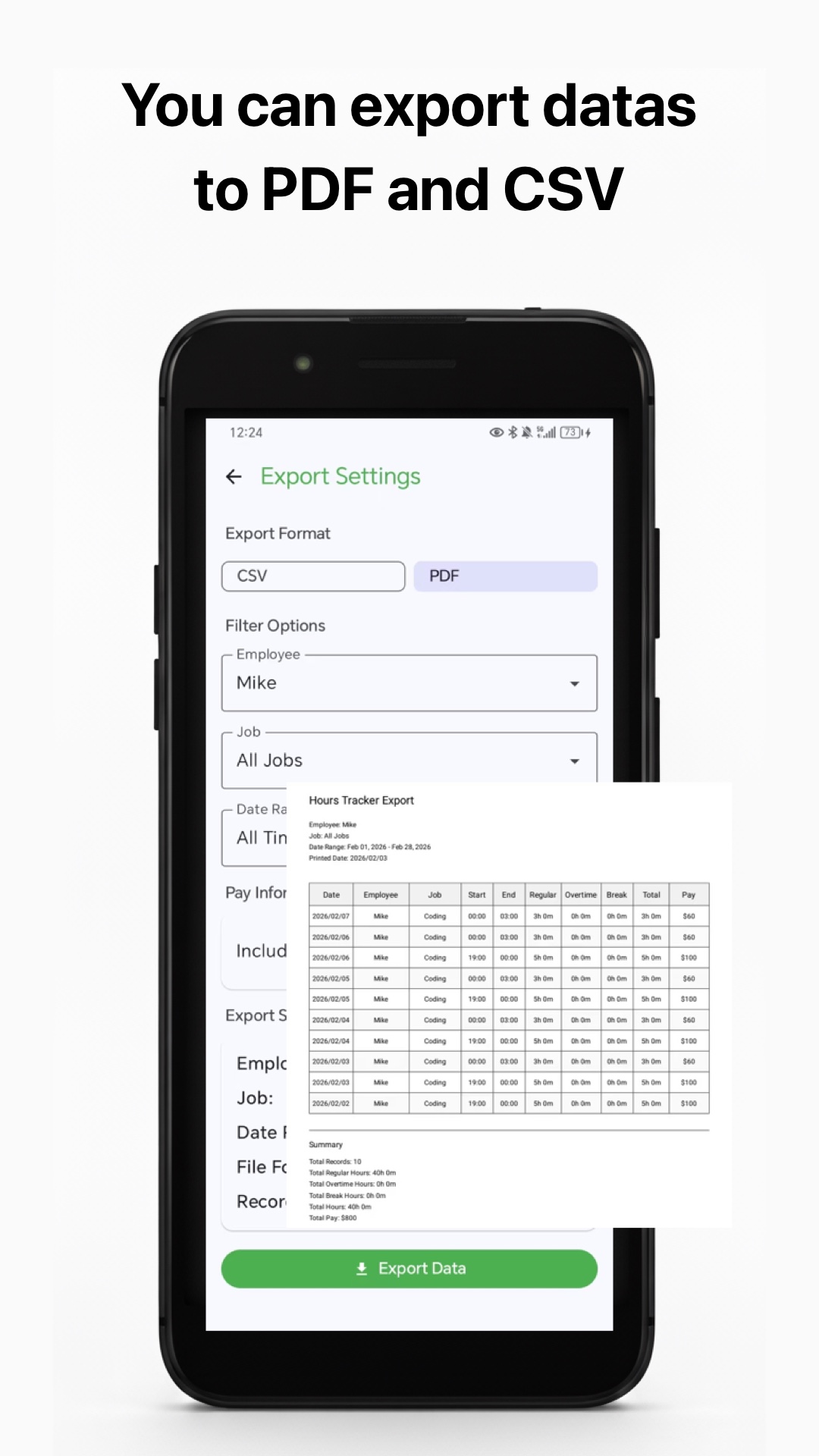
- 📄 Export clean reports: download professional PDF and CSV timesheets to verify your paycheck and resolve discrepancies with HR.
👉 Download ShiftWorkLog free on the App Store — never let your overtime go uncounted again.
Prefer to check the math first? Use the free time and a half calculator.
Frequently Asked Questions (FAQ)
What is time and a half pay?
Time and a half is an overtime pay rate equal to 1.5 times your regular hourly wage. Under the Fair Labor Standards Act (FLSA), it is the mandatory minimum rate for non-exempt hourly employees who work more than 40 hours in a workweek.
How do you figure out time and a half?
Multiply your regular hourly pay rate by 1.5. If you earn $20 per hour: $20 × 1.5 = $30 per hour for every overtime hour worked.
Does time and a half apply after 8 hours a day or 40 hours a week?
Under federal US law (FLSA), overtime is based on working over 40 hours in a standard workweek. However, certain states — including California, Nevada and Alaska — require time and a half for hours worked beyond 8 hours in a single workday.
What is time and a half for $20 an hour?
Time and a half for $20 an hour is $30.00 per hour ($20 × 1.5 = $30).
What is time and a half for $25 an hour?
Time and a half for $25 an hour is $37.50 per hour ($25 × 1.5 = $37.50).
Can salaried employees get time and a half?
Yes, if they are classified as non-exempt salaried employees earning under the federal salary threshold or not meeting the executive, administrative or professional exemption tests.
Is overtime taxed higher than regular pay?
No. Overtime pay is taxed at the same standard income tax brackets. A larger paycheck can temporarily push that pay period into a higher withholding bracket, so employers may withhold a higher percentage — but you receive any excess withholding back when you file your annual tax return.